
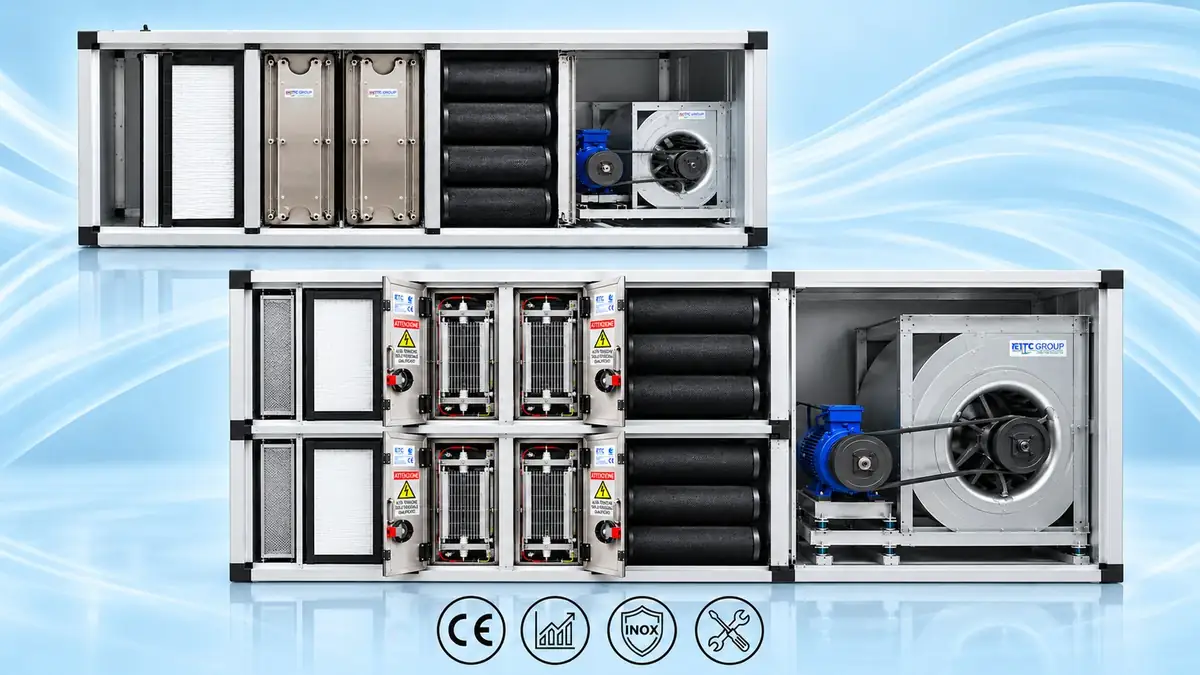
The number of stages determines the treatment
1, 2 or 3 electrostatic stages: three levels of treatment
The electrostatic stages of ARTURO use the same ESC cells as the NEXION filters. Air passes through them in series: each stage treats again the air already treated by the previous one. G4 and F9 always come first, activated carbon after.
Basic treatment
90%smoke, grease and particulate
70%odours
For moderate smoke and grease loads. Section pressure drop: 80 Pa.
Double treatment in series
95%smoke, grease and particulate
85%odours
The second stage treats again the air leaving the first. This is the configuration ETC Group recommends as the starting point for commercial kitchens. Pressure drop: 160 Pa.
Maximum performance
Highest efficiencyvalues per individual supply
For cooking with heavy smoke and grease and for exhausts with stricter requirements. Pressure drop: 240 Pa.
Efficiencies of the electrostatic section only, at nominal airflow, with clean cells. On each system they depend on actual airflow, type of cooking and washing frequency. Each additional stage adds about 80 Pa, which the fan must overcome.
Complete supply
Every ARTURO comes with ozone and control panel
Ozone generator sized to the airflow
The ETC CUBIK or COMPACT ozone generator comes with every ARTURO and is selected on the airflow required by the system: the starting point is 10 g/h per 1,000 m³/h, from 34 g/h on ARTURO 30 to 272 g/h on ARTURO 240. It is mounted above the hood and injects ozone upstream of the activated carbon, which retains the residual ozone.
An inverter panel that controls the whole system
The control panel with Toshiba VF-S15 inverter manages fan, electrostatic cells and ozone generator from a single point. It regulates airflow, soft-starts the fan and enables cells and ozone only while extraction is running. Wiring diagram ETC0002024.
Choose the size
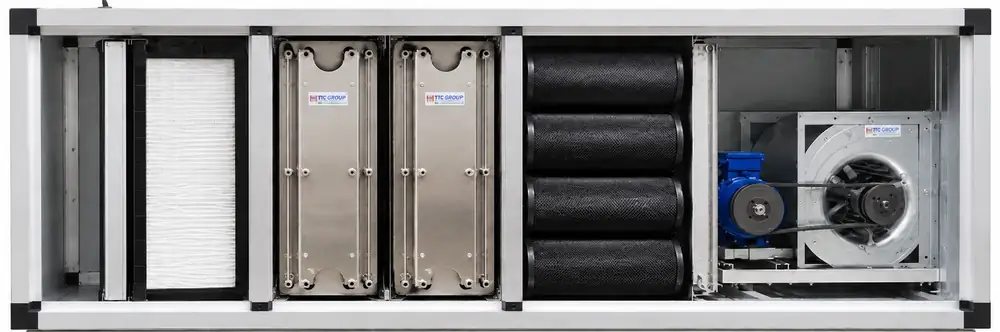
Every size uses the same components; the number of filter modules, the fan and the cabinet dimensions change. Photo representative of the size.
| ARTURO 30 | |
|---|---|
| Maximum airflow | 3,400 m³/h |
| External static pressure | 400 Pa |
| Fan | 9/9 · 1,5 kW |
| Fan type | belt-driven double-inlet, IE3 IP55 motor |
| Dimensions A × B × H | 220 × 73 × 73 cm |
| Indicative weight | 280 ÷ 320 kg |
| Full + half filter modules | 1 + 0 |
| Electrostatic cells per stage | 1 × ESC 6060 |
| CCA140 carbon cartridges | 16 pcs · 48 kg of carbon |
| Ozone generator supplied | 34 g/h · e.g. COMPACT Com.40 |
| Inverter control panel | standard, controls the whole system · Toshiba VF-S15 |
Dimensions with 1 electrostatic stage: each additional stage adds a section. Indicative weight without carbon.
Dimensions and weights are indicative and must not be used as a design basis. Actual machine drawings are supplied only after construction and on explicit request: ETC Group S.r.l. accepts no liability for drawings or dimensions not expressly requested after the machine has been built.
Complete range ARTURO 30 ÷ 240
| Model | Max airflow m³/h | External static pressure Pa | Fan | A × B × H cm | Weight kg | ESC cells per stage | CCA140 cartridges | Ozone g/h |
|---|---|---|---|---|---|---|---|---|
| ARTURO 30 | 3,400 | 400 | 9/9 · 1,5 kW | 220 × 73 × 73 | 280 ÷ 320 | 1 × ESC 6060 | 16 | 34 |
| ARTURO 45 | 5,100 | 400 | 12/12 · 2,2 kW | 220 × 103 × 73 | 350 ÷ 420 | 1 × ESC 6060 + 1 × ESC 3060 | 24 | 51 |
| ARTURO 60 | 6,800 | 400 | 12/12 · 3 kW | 240 × 130 × 73 | 450 ÷ 550 | 2 × ESC 6060 | 32 | 68 |
| ARTURO 75 | 8,500 | 400 | 15/15 · 4 kW | 240 × 160 × 73 | 550 ÷ 680 | 2 × ESC 6060 + 1 × ESC 3060 | 40 | 85 |
| ARTURO 90 | 10,200 | 400 | 15/15 · 4 kW | 290 × 130 × 103 | 600 ÷ 750 | 3 × ESC 6060 | 48 | 102 |
| ARTURO 120 | 13,600 | 400 | 18/18 · 5,5 kW | 300 × 130 × 130 | 800 ÷ 980 | 4 × ESC 6060 | 64 | 136 |
| ARTURO 150 | 17,000 | 600 | TLZ 500 · 5,5 kW | 340 × 140 × 160 | 1,000 ÷ 1,300 | 4 × ESC 6060 + 2 × ESC 3060 | 80 | 170 |
| ARTURO 180 | 20,400 | 400 | TLZ 560 · 7,5 kW | 360 × 190 × 160 | 1,400 ÷ 1,800 | 6 × ESC 6060 | 96 | 204 |
| ARTURO 240 | 27,200 | 400 | TLZ 630 · 11 kW | 380 × 254 × 160 | 1,900 ÷ 2,400 | 8 × ESC 6060 | 128 | 272 |
A = length in the direction of airflow, B = width, H = height. Airflows from 27,200 to 50,000 m³/h: custom-engineered configurations.
Dimensions and weights are indicative and must not be used as a design basis. Actual machine drawings are supplied only after construction and on explicit request: ETC Group S.r.l. accepts no liability for drawings or dimensions not expressly requested after the machine has been built.
How ARTURO works
Air from the hoods passes through five stages in sequence. The fan is downstream of the filters and handles air that has already been cleaned, so the impeller does not get coated with grease.
Ozone in the hood
The generator injects ozone into the hood, with at least 3 seconds of contact time before the filters.G4 and F9
They retain particles, fine particulate and grease.ESC cells
The electrostatic cells charge and collect smoke and grease particles.Activated carbon
The cartridges adsorb odours and residual ozone.Fan
With control panel and Toshiba VF-S15 inverter as standard.Electrostatic stages at a glance
| Stages in series | Smoke, grease and particulate | Odours, indicative | Pressure drop |
|---|---|---|---|
| 1 stage | 90% | 70% | 80 Pa |
| 2 stages | 95% | 85% | 160 Pa |
| 3 stages | highest efficiency | per supply | 240 Pa |
Electrostatic section only, at nominal airflow, clean cells. For commercial kitchens ETC Group recommends the double stage.
Standard on every ARTURO
- G4 ISO Coarse 55% prefilter and F9 rigid bag filter ePM1 85%, replacement at 250 Pa
- ESC 6060 and ESC 3060 aluminium electrostatic cells, ceramic insulators, washable
- One ESC HV power supply per stage, 8-12 kV DC output
- CCA140 bayonet-fit activated carbon cartridges, refillable
- Double-inlet fan with IE3 IP55 motor (sizes 30-120) or direct-drive TLZ (150-240)
- Control panel with Toshiba VF-S15 inverter that controls the whole system, wiring diagram ETC0002024
- CUBIK or COMPACT ozone generator sized to the required airflow
- Interlocks: cells and ozone enabled only with the fan running
- Cabinet in P40 aluminium profiles and 25 mm sandwich panels, 40 dB sound insulation, Sx and Dx versions
Certifications and tests, with their numbers
Ozone generator supplied with ARTURO
The starting dosage is 10 g/h per 1,000 m³/h, to be adjusted on each system. The CUBIK or COMPACT generator is supplied with ARTURO and controlled by its panel. It has its own CE marking and manual (ETC-MAN-O3-2026) and is mounted above the hood or on the first section of duct, always upstream of the activated carbon. The size for each model is given in the range table.
Manual
Technical documentation
100 questions from designers and installers
Answers taken from manual ETC-MAN-ARTURO-001 Rev. 02 and from the ARTURO 30 ÷ 240 datasheet.
Product and application
1.What is the ARTURO cabinet air purifier?
It is a complete system for the air extracted by commercial kitchen hoods: in a single cabinet, G4 prefilter, F9 rigid bag filter, 1 to 3 stages of electrostatic cells, activated carbon cartridges and fan. It is supplied with the ozone generator sized to the required airflow and with the inverter control panel that runs the whole system. ETC Group patent no. 102022000000572.
2.What types of premises is ARTURO installed in?
Restaurants, pizzerias, rotisseries, fish and chip shops, delicatessens, canteens and food production units: commercial kitchens with an extraction hood.
3.What is the difference between ARTURO cabinet and ARTURO INOX?
The cabinet series has a frame in P40 aluminium profiles and sandwich panels, in 9 sizes from 3,400 to 27,200 m³/h. ARTURO 30 INOX and ARTURO 60 INOX are the enclosed stainless steel versions.
4.What is the ARTURO cabinet derived from?
From the BFMT activated carbon unit of the same size: the electrostatic section fits into the same cabinet and keeps its width and height. Only the length changes.
5.What does each ARTURO stage retain?
The G4 retains coarse particles, the F9 fine particulate and grease droplets, the electrostatic cells smoke and grease particles, the activated carbon odour molecules and residual ozone.
6.Why is the fan downstream of the filters?
It handles air that has already been cleaned, so the impeller does not get coated with grease and maintains its performance over time.
7.Does ARTURO replace the kitchen hood?
No. It works downstream of the hood grease filters, and the hood must be sized separately. Without grease filters, grease clogs the prefilters within a few days and reaches the carbon.
8.Does ARTURO count as authorisation to discharge kitchen fumes?
No. The machine treats the air, while checking local regulations and permits is the responsibility of the designer and the business owner.
9.Can ARTURO be used with wood-fired ovens, grills or charcoal braziers?
Not on its own: a stage for removing sparks, embers, soot and heat is needed first. The activated carbon works with air up to 40 °C.
10.Which uses are prohibited?
Explosive atmospheres, flammable gases or dusts, air above 40 °C or 70% relative humidity, operation without prefilters, with cells missing or with access doors open, ozone generator on with extraction stopped, washing with water jets.
Selection and sizing
11.How many sizes are there in the cabinet series?
Nine: ARTURO 30, 45, 60, 75, 90, 120, 150, 180 and 240, with maximum airflows from 3,400 to 27,200 m³/h.
12.What does the number in the model name mean?
The maximum airflow in hundreds of m³/h, rounded: ARTURO 60 handles up to 6,800 m³/h, ARTURO 120 up to 13,600 m³/h.
13.How do I choose the right ARTURO size?
Add up the airflow of the connected hoods and choose the size with a maximum airflow equal to or greater than that. The operating airflow is then set with the inverter.
14.Is there an intermediate ARTURO size?
No. Each size is made up of full 610 × 610 mm modules or half 305 × 610 mm modules: for an intermediate airflow, choose the next size up and adjust it with the inverter.
15.Can airflows above 27,200 m³/h be treated?
Yes, up to 50,000 m³/h, with custom-engineered configurations developed by ETC Group S.r.l.
16.What is the external static pressure and what is its value?
It is the static pressure the fan leaves available for hood and ducts, with clean filters and at maximum airflow: 400 Pa on all sizes, 600 Pa on ARTURO 150.
17.What is the pressure drop across the machine filters?
About 450 Pa with clean filters and cartridges, a value that increases as they get dirty. Each electrostatic stage adds about 80 Pa.
18.What are the dimensions of ARTURO?
Approximately from 220 × 73 × 73 cm for ARTURO 30 to 380 × 254 × 160 cm for ARTURO 240 (length × width × height); each additional electrostatic stage adds a section. These are hypothetical dimensions, not to be used as a design basis: actual drawings are only available once the machine has been built and on explicit request.
19.How much does ARTURO weigh?
From 280-320 kg for ARTURO 30 to 1,900-2,400 kg for ARTURO 240, without carbon. The carbon ranges from 48 to 384 kg depending on the size. These are indicative weights; the exact weight of the supply is on the delivery note.
20.What are the Sx and Dx versions?
Looking at the machine from the access door side, in the Sx version the air exits on the left, in the Dx version on the right. It is chosen when ordering. Large sizes can be supplied in several modules to be joined on site.
Electrostatic stages and ESC cells
21.How many electrostatic stages can ARTURO have?
One, two or three in series, chosen when ordering and stated in the order confirmation. Each stage is a bank of cells covering the whole cross-section.
22.What efficiency do the electrostatic stages achieve?
With 1 stage 90% on smoke, grease and particulate and 70% on odours; with 2 stages 95% and 85%; with 3 stages the efficiency rises further and the values are given in the documentation of the individual supply. Data for the electrostatic section only, at nominal airflow, with clean cells.
23.How many electrostatic stages does a commercial kitchen need?
ETC Group recommends starting with two stages. The final number is decided at design stage based on the type of cooking, the amount of smoke and grease and the discharge conditions.
24.How does an electrostatic cell work?
It is a two-stage design: in the ionisation zone the electrodes charge the smoke and grease particles, in the collection zone the collector plates retain them until washing.
25.Which cells does ARTURO use?
ESC 6060, 60 × 60 × 30 cm, up to 3,400 m³/h each, and ESC 3060, 30 × 60 × 30 cm, up to 1,700 m³/h. Sizes 45, 75 and 150 also use the half cell.
26.How do the ARTURO stages relate to the NEXION filters?
The electrostatic stages of ARTURO use the same ESC cells as the NEXION filters. 1, 2 and 3 stages correspond to the NEXION, NEXION X and NEXION XX configurations: air passes through them in series and each stage treats again the air already treated by the previous one. The cells operate at a face velocity of about 2.7 m/s at maximum airflow.
27.What material are the cells made of?
Aluminium frame and plates, ceramic insulators, stainless steel pins and springs. They slide out from the front on rails, without tools.
28.How are the cells powered?
Each stage has its own ESC HV power supply, mounted inside the panel door: input 230 V single-phase 50 Hz, output 8-12 kV DC.
29.How often should the electrostatic cells be washed?
Typically every 3-4 weeks, every 2 weeks with grills and fryers, with a visual inspection every 2 weeks. The correct frequency is set on each system.
30.How are the electrostatic cells washed?
In warm water at 40-50 °C with a 1-2% neutral degreaser for 15-20 minutes, in a dishwasher or with ETC SONIWASH ultrasonic washers. Then rinse and dry completely: a damp cell causes arcing.
31.What should not be used to wash the cells?
Caustic soda, strong alkaline detergents, concentrated acids and pressure washers: they corrode the aluminium, damage the insulators and deform plates and rails.
32.Can a bent cell be straightened?
No, it must be replaced. Bending electrodes or plates changes the distances between live parts and can cause arcing and short circuits.
Filters and activated carbon
33.Which mechanical filters does ARTURO use?
G4 ISO Coarse 55% prefilter (592 × 592 × 48 mm) and F9 rigid bag filter ePM1 85% (592 × 592 × 292 mm), with half sizes on sizes 45, 75 and 150.
34.How often should the G4 and F9 filters be replaced?
The G4 every 15-30 days, the F9 every 30-60 days, or in any case when the pressure drop reaches 250 Pa.
35.Can the G4 and F9 filters be washed?
No, they are consumables. On request the G4 can be replaced with a metal G2 prefilter, washable in hot water with neutral degreaser.
36.Which carbon cartridges does ARTURO use?
CCA140 cartridges, Ø 140/70 × 400 mm with bayonet fitting, each containing about 3 kg of virgin granular carbon of mineral origin, mounted on plates of 16 or 8.
37.How many carbon cartridges does each size have?
From 16 cartridges and 48 kg of carbon on ARTURO 30 to 128 cartridges and 384 kg on ARTURO 240.
38.How long does the activated carbon last?
In a kitchen with normal service it is replaced every 6-12 months; with grills and very intensive cooking, as often as every 2 months. The first sign is odour returning at the outlet.
39.Are the carbon cartridges refillable?
Yes, with loose carbon of the same type and in the same quantity. ETC Group supplies it in 25 kg bags (code SCA25KG).
40.What are the operating limits of the cartridges?
Air up to 40 °C and 70% relative humidity. They must not get wet: damp carbon loses adsorption capacity.
41.How should spent carbon cartridges be disposed of?
Sealed in bags without shaking them, away from heat sources and never stored in enclosed rooms. The EWC waste code is assigned based on the substances retained during operation.
42.Can filters be added for specific odours?
Yes: flat panel filters with activated carbon, alumina or zeolite. The airflow and the pollutant to be treated must be specified when ordering.
Ozone generator
43.Is the ozone generator included in the supply?
Yes. Every ARTURO comes with the ETC ozone generator sized to the airflow required by the system, controlled by the ARTURO panel. The generator has its own CE marking, manual (ETC-MAN-O3-2026) and declaration of conformity.
44.Why does ARTURO work together with an ozone generator?
Ozone injected into the hood oxidises part of the odorous substances before the machine and reduces the load on the activated carbon. The carbon downstream retains the residual ozone.
45.How does the ozone generator work?
It draws in room air through a filter, passes it between high-voltage emitters and sends the ozone into the hood, where it oxidises volatile grease and odour molecules.
46.How is the supplied ozone generator sized?
On the required airflow: the starting dosage is 10 g/h per 1,000 m³/h of treated air, then it is adjusted to the type of cooking, the workload and the available contact time.
47.Which ozone generator goes with each ARTURO size?
Starting examples: ARTURO 30 COMPACT Com.40, 45 Com.60, 60 Com.80, 75 CUBIK O3-100, 90 O3-120, 120 O3-120 + Com.20, 150 O3-180, 180 O3-180 + Com.40, 240 O3-180 + O3-100.
48.Where is the ozone injected?
Into the hood or immediately downstream of the fume source, always upstream of the activated carbon, with at least 3 seconds of contact time before the air purifier. The carbon retains the residual ozone.
49.How much ozone leaves the exhaust?
In Greenlab reports 2877/19 and 0995/25, ozone at the outlet was below 0.05 mg/Nm³, on systems with 1 electrostatic stage and a 40 g/h generator.
50.What is the difference between CUBIK and COMPACT?
CUBIK has a hexagonal body with six housings for the emitters (models from O3-30 to O3-180); COMPACT is smaller (models from Com.10 to Com.120).
51.Where should the ozone generator be installed?
Indoors only, between 0 and 40 °C and with relative humidity between 35 and 70% non-condensing, at least 30 cm from flammable materials, with the sign indicating that the generator is in operation.
52.Can the ozone generator be used to sanitise rooms?
No. It is not used to sanitise rooms, surfaces or food, and ozone must not be released into spaces occupied by people or animals.
Fan, control panel and inverter
53.Which fan does ARTURO use?
Up to ARTURO 120, a double-inlet centrifugal fan with forward-curved blades, belt-driven with V-belts and a belt-tensioning slide rail. From ARTURO 150, TLZ direct-drive fans, without belts.
54.Are the control panel and inverter included?
Yes, as standard on all sizes. A single control panel with Toshiba VF-S15 inverter controls the whole system: fan, electrostatic cells and ozone generator, with the safety interlocks. Wiring diagram ETC0002024.
55.What is the inverter for?
It soft-starts the fan, reduces stress on belts and bearings, sets the airflow to the design value and protects the motor from thermal overload.
56.How should the inverter be set up?
Maximum frequency 50 Hz, recommended minimum 30 Hz, acceleration and deceleration ramps of at least 14 seconds, motor rated current as per rating plate.
57.What is the maximum fan speed?
9/9: 2,100 rpm; 12/12: 1,600; 15/15: 1,300; 18/18: 1,100. For TLZ fans the rating plate data apply. The limits also apply with the inverter.
58.What maintenance do the fan bearings need?
No greasing: they are sealed, lubricated for life, with a minimum theoretical life of 30,000 hours. The impeller is balanced to VDI 2060, grade Q 6.3.
59.How noisy is ARTURO?
The panels provide 40 dB of sound insulation; the configuration tested by IMQ measured 70 dB. At the installation site noise is measured during acceptance testing; attenuators with splitters reduce it by 15-20 dB(A).
60.Who checks the noise limits?
The installer and the client, in accordance with D.P.C.M. 14/11/1997 and the municipal acoustic zoning plan. It is advisable to assess them at design stage.
Installation and ductwork
61.Who installs ARTURO?
Companies or persons meeting the requirements set by law. ETC Group supplies the machine; positioning, brackets, ducts and connections are the installer's responsibility, unless otherwise agreed in writing. On request ETC Group assesses installation with a dedicated quotation.
62.Where can ARTURO be installed?
In a covered room or enclosure, with ambient temperature from -20 to +45 °C, away from heat, steam and flammable substances. Outdoors, the cover listed among the accessories is required.
63.How much maintenance clearance does ARTURO need?
At least 750 mm in front of the electrostatic section and 600 mm in front of the other sections, plus 150 mm from the walls at the high-voltage power supplies.
64.How is ARTURO installed suspended from the ceiling?
Supported under the base frame with sections or brackets, with supports sized for the weight including carbon plus 50% (minimum 200 kg), level within ±2° and with anti-vibration mounts.
65.Which anchors are required?
Mechanical anchors on solid concrete, chemical anchors on hollow brick, bolts at least M8 in stainless or galvanised steel with self-locking nuts. The calculation is the responsibility of the designer or structural engineer.
66.How is ARTURO installed on the floor?
On a flat base or on the adjustable feet supplied as an option, properly levelled; on lightweight floors, with anti-vibration mats or mounts.
67.Why is an inlet transition needed?
It distributes the air over the whole cross-section. With the duct connected directly to the panel, air passes through only part of the filters, cells and cartridges, which clog and saturate sooner.
68.How should the ducts be connected?
With flexible connectors on inlet and outlet, straight runs of at least 2.5 diameters before and after the machine, 45° or 30° bends after the fan and velocity not exceeding 12 m/s.
69.How is airtightness ensured?
By sealing all flanges with butyl tape or neutral-cure silicone: every leak is an air path that bypasses the filters.
70.Can the openings be left unconnected?
Only with safety guards with a mesh no larger than 12 mm, in accordance with UNI EN ISO 13857. Otherwise they must be connected to ducts at least 900 mm long.
71.When is a demister needed?
Where cooking produces a lot of steam and grease aerosols: it is mounted on the duct between hood and air purifier, with a drip tray, drain and trap.
72.How is the grease drain connected?
To a dedicated trap with a minimum fall of 2%, never to a pressurised pipe, filling the trap before start-up.
73.How is ARTURO lifted?
With a forklift or slings and a spreader bar under the base frame. The centre of gravity is offset towards the fan. Never lift it by the openings, panels, handles or motor.
74.What should be checked on delivery?
Number of packages, condition, model, number of stages, Sx or Dx version and serial number. Damage must be recorded as a specific reservation on the carrier's document and reported within 24 hours. Delivery terms are EXW Tavullia (Incoterms 2020).
75.How should ARTURO be stored before installation?
In a covered, dry room, from -10 to +45 °C, with cartridges and filters in their sealed packaging away from solvents and paints. If stored for more than 3 months, turn the impeller by hand every month.
Electrical connection and safety
76.How is the fan powered?
At 400 V three-phase 50 Hz via the inverter. Alternatively, depending on the version ordered, with 230 V single-phase input, single-phase inverter and motor connected in delta.
77.How are the electrostatic cells powered?
With a dedicated 230 V single-phase 50 Hz line, protected by a 30 mA type A RCD and an MCB sized on the number of power supplies.
78.How is the ozone generator powered?
At 220-240 V single-phase 50 Hz, on a line with dedicated RCD and MCB and earth resistance not exceeding 10 ohm.
79.Which standards apply to the electrical connection?
D.M. 37/2008, CEI 64-8 and CEI EN 60204-1, following wiring diagram ETC0002024, by qualified personnel. The earth conductor is connected first.
80.Which interlocks are mandatory?
Cells and ozone are enabled only with the fan running and switch off immediately if it stops; at normal shutdown the ozone switches off first and the fan keeps running for purging; no unintended automatic restart when mains power returns.
81.Why wait 10 minutes before opening the machine?
The cells remain charged even with the machine switched off, and the inverter capacitors for at least 5 minutes. After the wait the cells are discharged to earth with an insulated tool.
Commissioning, use and maintenance
82.Who carries out commissioning?
The installer, once the system is complete, filling in the commissioning record attached to the manual.
83.How is the direction of rotation checked?
With a 3-5 second pulse with the access doors closed. If the impeller turns the wrong way, reverse the inverter direction parameter or swap two phases downstream of the inverter.
84.What do the power supply indicator lights mean?
Green LED: cells operating. Red LED: alarm for prolonged arcing or fault. Crackling below 5 per minute: wash within a week; above 10 per minute: wash immediately.
85.How is ARTURO used day to day?
Switch on extraction from the panel before cooking; cells and ozone start with the fan. During operation access doors and panel doors remain closed. At shutdown the ozone stops first and the fan completes the purge.
86.How often should the fan belts be checked?
After the first 8-24 hours, then every 3 months. The complete set is replaced every 15,000 hours or earlier if worn. Tension is measured with the deflection method: f = T × 1.5 / 100.
87.What is the annual maintenance schedule?
Every 6 months pulleys, bearings, ozone generator and interlock test; every 12 months overhaul of insulators, electrodes and power supplies, cleaning of impeller and cabinet, electrical tests on the control panel.
88.How often should the hood and ducts be cleaned?
The hood grease filters every week; the ducts by a specialist company, with a report, 1 to 4 times a year depending on use, with reference to the UNI EN 16282 series.
89.What should I do if odour returns at the outlet?
Check for saturated carbon, missing or unlocked cartridges, badly closed access doors and excessive airflow; then check the ozone dosage.
90.What should I do if the hood extraction is weak?
The most common causes are clogged G4 or F9, dirty cells, loose belts, an obstructed duct or reversed rotation: replace the filters, wash the cells and measure the airflow.
91.What should be done in the event of a fire?
Isolate the machine, close the fire dampers, activate the hood fire suppression system if present, do not use water on grease or live parts, do not open the access doors while the machine is hot, and call 115.
Certifications, warranty and documents
92.What certifications does ARTURO have?
CE marking under Directive 2006/42/EC, 2014/30/EU and 2011/65/EU, IMQ N. 364 Rev. 0 certificate dated 29/06/2026, valid until 28/06/2031, IMQ test report MA26-0131385 to IEC 60204-1, patent no. 102022000000572 granted on 17/01/2024.
93.What emission tests are available?
Greenlab Group S.r.l., laboratory ACCREDIA LAB n. 0788, report 2876/19: total dust 3.2 mg/Nm³ (UNI EN 13284-1) and VOC 17 mg/Nm³ (UNI EN 12619). The values refer to the systems measured; each new system depends on cooking, airflow, ducts and maintenance.
94.Can an authority require additional national certifications?
For a compliant, CE-marked machine, Directive 2006/42/EC (Art. 6), and from 20/01/2027 Regulation (EU) 2023/1230 (Art. 4), prohibit restricting its placing on the market. Any restrictive measure must be justified in writing and notified to the manufacturer.
95.What warranty does ARTURO have?
12 months from the date of the delivery note against manufacturing and assembly defects, for sales to businesses and professionals with a VAT number. Consumables and damage from non-compliant use or installation are excluded.
96.What is required to keep the warranty valid?
A service contract with a qualified installer or maintenance technician within 10 days of installation and submission of the installation certificate to ETC Group.
97.Which spare parts are available?
ESC 6060 and ESC 3060 cells, ESC HV power supplies, electrodes, springs, insulators and pins, CCA140 cartridges, PCCA1X16 and PCCA1/2X8 plates, G4 and F9 filters, SCA25KG loose carbon, belts, pulleys, motors and generator spare parts. Always quote model and serial number.
98.Which accessories can be ordered?
Additional electrostatic stages, demister, metal G2 prefilter, special flat panel filters, differential pressure switch, inlet transition, attenuator, outdoor cover, adjustable feet, brackets and SONIWASH ultrasonic washer.
99.What documentation comes with the machine?
The installation, use and maintenance manual ETC-MAN-ARTURO-001 Rev. 02, the EC declaration of conformity with the serial number and wiring diagram ETC0002024. The datasheet can be downloaded freely from the website.
100.How do I contact technical support?
ETC Group S.r.l., Tavullia (PU): tel. +39 0541 1646150, WhatsApp +39 373 7755779, informazioni@etcgroupsrl.biz, Monday to Friday 08:00-12:00 and 13:00-17:00, quoting model and serial number.